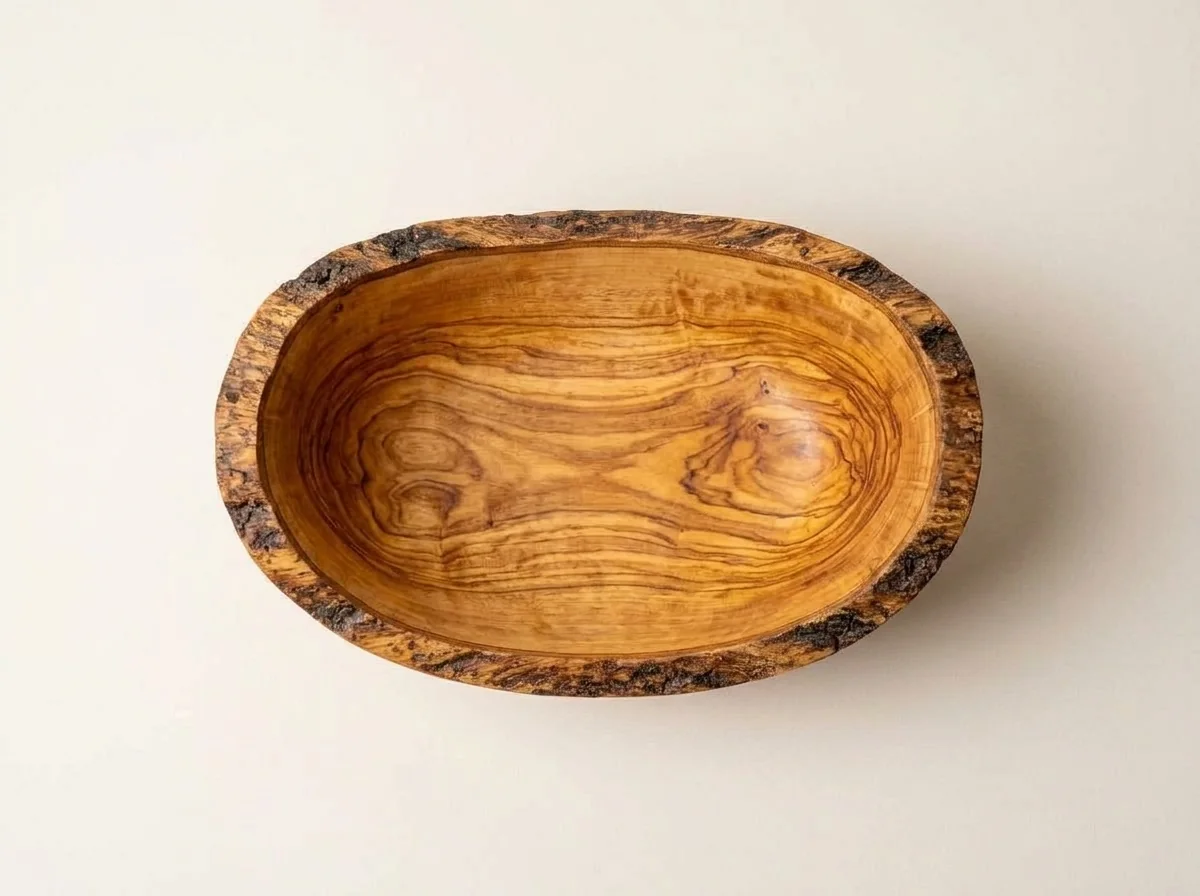
An Italian woodcarver refused $29 a bowl for all 142, and 19 are still unclaimed
Ostuni, Puglia. Every bowl is hollowed from a single trunk of a tree that stopped fruiting after a century, so no two grains repeat. The last 142 go straight to American tables at $87, against a $198 list price.
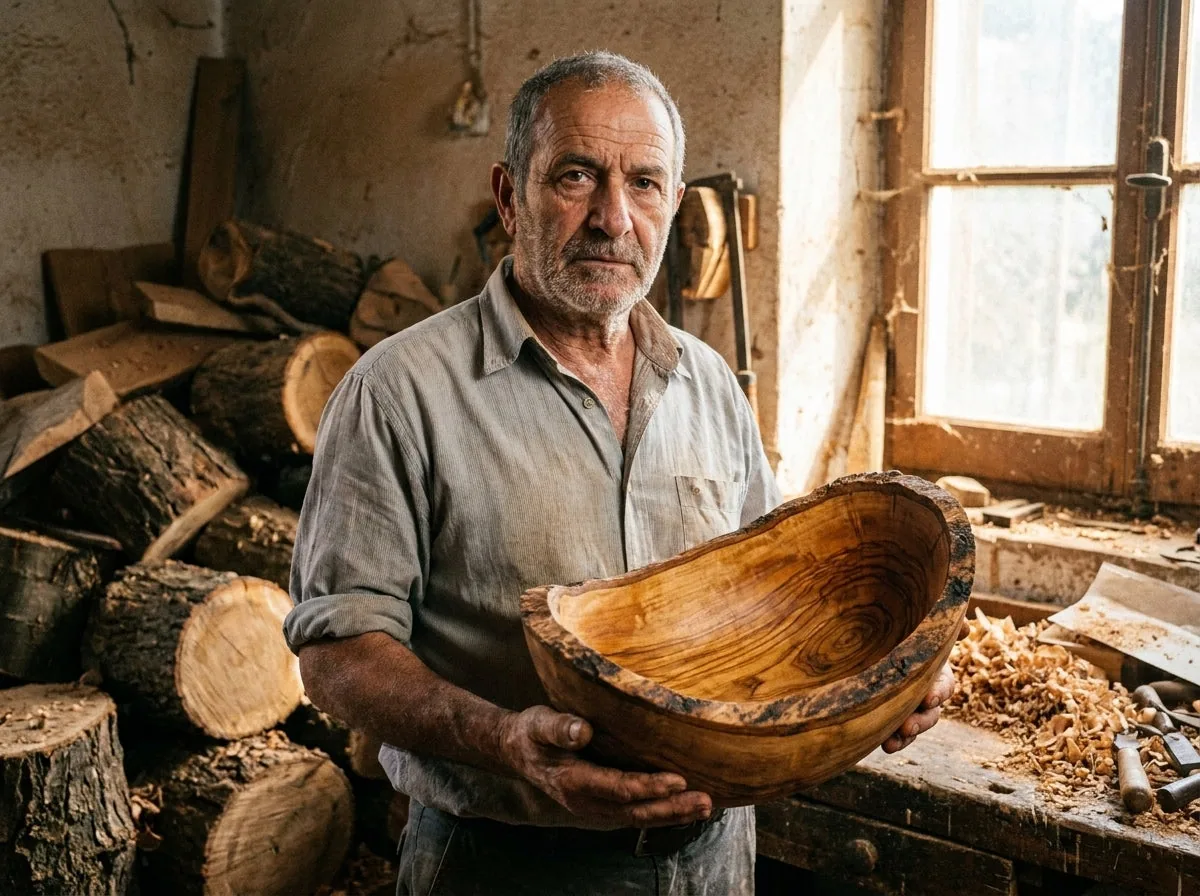
This March, a shoulder surgeon in Brindisi told Salvatore Ricci, 64, that the torn rotator cuff in his right shoulder gave him about one working winter. “I can still read a trunk with my thumbs,” he says quietly, “but the gouge will not answer me by spring.”
He spent that winter in the workshop. 142 finished bowls now sit on the drying racks of a small workshop on the white edge of Ostuni, in Puglia, each one hollowed out of a single dead olive trunk the way he has hollowed them for 27 years. He has turned down every buyer who asked for the lot, and he will not release a single bowl to a shop shelf.
The reason sits in a biscuit tin of letters in the back room. For 27 years the bowls leaving this workshop were ordered in November and December more often than in any other month, and almost never by the person who ended up keeping them. So the last 142 are not going to a warehouse. They go direct to American households at $87, against a list price of $198.
How a Trunk Nobody Wanted Becomes the Bowl That Sits Out All Year
Salvatore did not choose the olive wood. The olive wood chose his family in 1964, the year his father loaded a borrowed cart in the Itria valley and brought back the first uprooted trunk of a tree that had stopped fruiting at 108.
His father, Domenico, worked the trade alone for 33 years, clearing dead groves across Puglia and Basilicata. Salvatore took over the workshop in 1999, the day Domenico's right hand finally failed him, and has carried the family wood trade since.
'An olive tree stops fruiting at 100 years,' Salvatore says, his palm flat inside a drying bowl. 'That is when I start working with her wood. She has fed 3 generations of someone. She still has another century to give.'
The bowls travel to Boston brownstones, Chicago suburbs, and Nashville bungalows, and a good number of them arrive in December. Customers write back 20 years later asking if Salvatore is still alive, because the bowl someone gave them for their first kitchen has not once split at the rim.
The First December Domenico Was Not in the Workshop
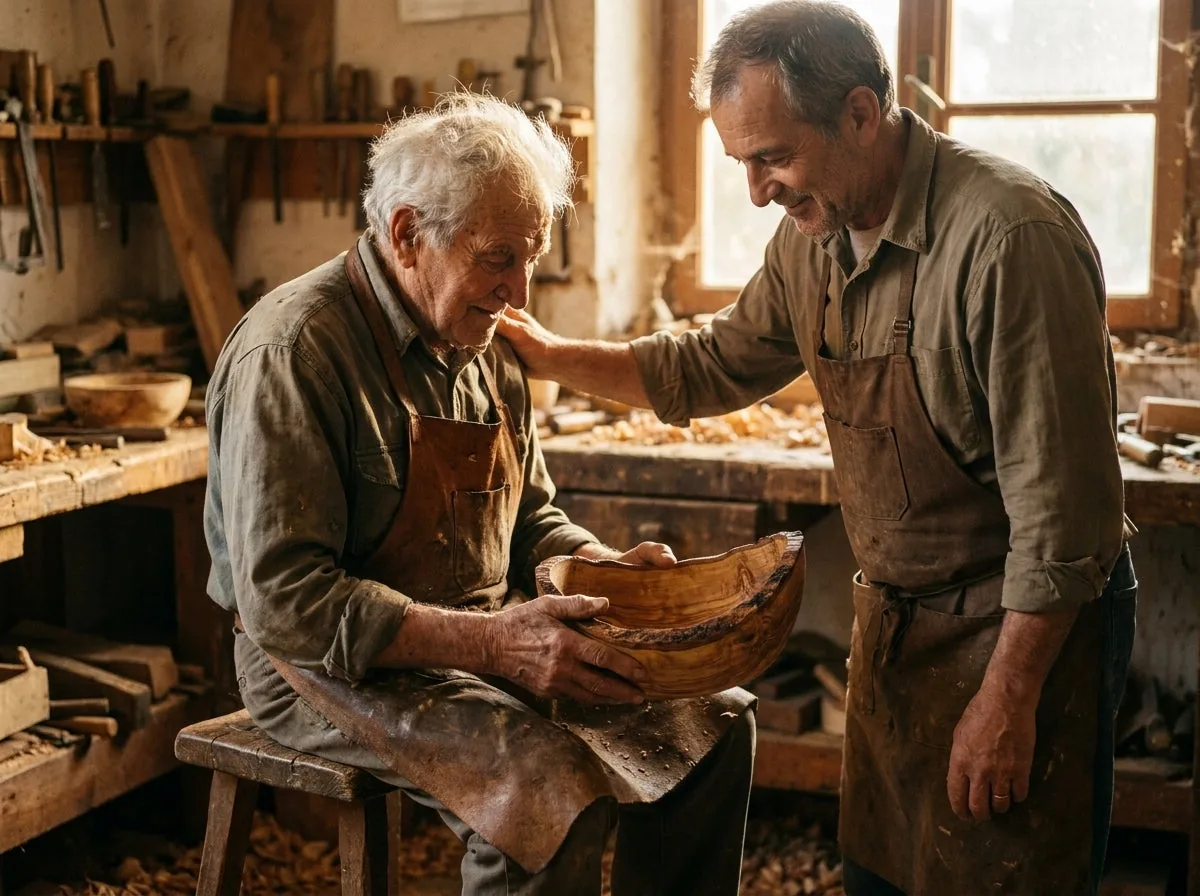
Domenico Ricci collapsed in the workshop on March 8, 2019, after a stroke he had hidden from the family for 3 weeks. He was 91. He had been the one who decided, in the late 1990s, that the workshop would only carry dead olive wood.
'You don't grieve a father,' Salvatore says. 'You grieve the silence he leaves in the room beside yours. I worked 20 years next to that man. The first morning without him, the workshop sounded wrong.'
He stopped answering the wholesaler's calls from Bari that spring. His wife Rosaria begged him to take a season off. His nephew Antonio, the only one in the family with the patience for the work, had already left for an engineering job in Milan.
On the third Tuesday after the funeral, Rosaria found him in the workshop at 4 in the morning, running his thumb around the bark rim of an unfinished bowl. He had not turned on the lights.
'The wood remembered him better than the photographs,' Salvatore says now. 'The grain my father pulled out of those valley trunks 50 years ago is in every bowl here. As long as I keep carving, he keeps teaching.'
Through 2020 and 2021, Salvatore shaped between 2 and 3 bowls per week. He stopped attending the Milan trade fair. He stopped returning the calls from the Bari distributor. The wholesaler eventually moved on to a factory in Romania. The only orders he still filled were the ones that arrived in November and December, from people buying for someone else.
By the spring of 2026, the drying racks held 142 finished bowls. Each one had been worked across 4 separate sessions in the workshop, oiled with cold-pressed linseed, and set aside in the cool back room of the workshop where the wood could continue to settle.
Why This Bowl Is Still Round 20 Winters After Someone Unwrapped It
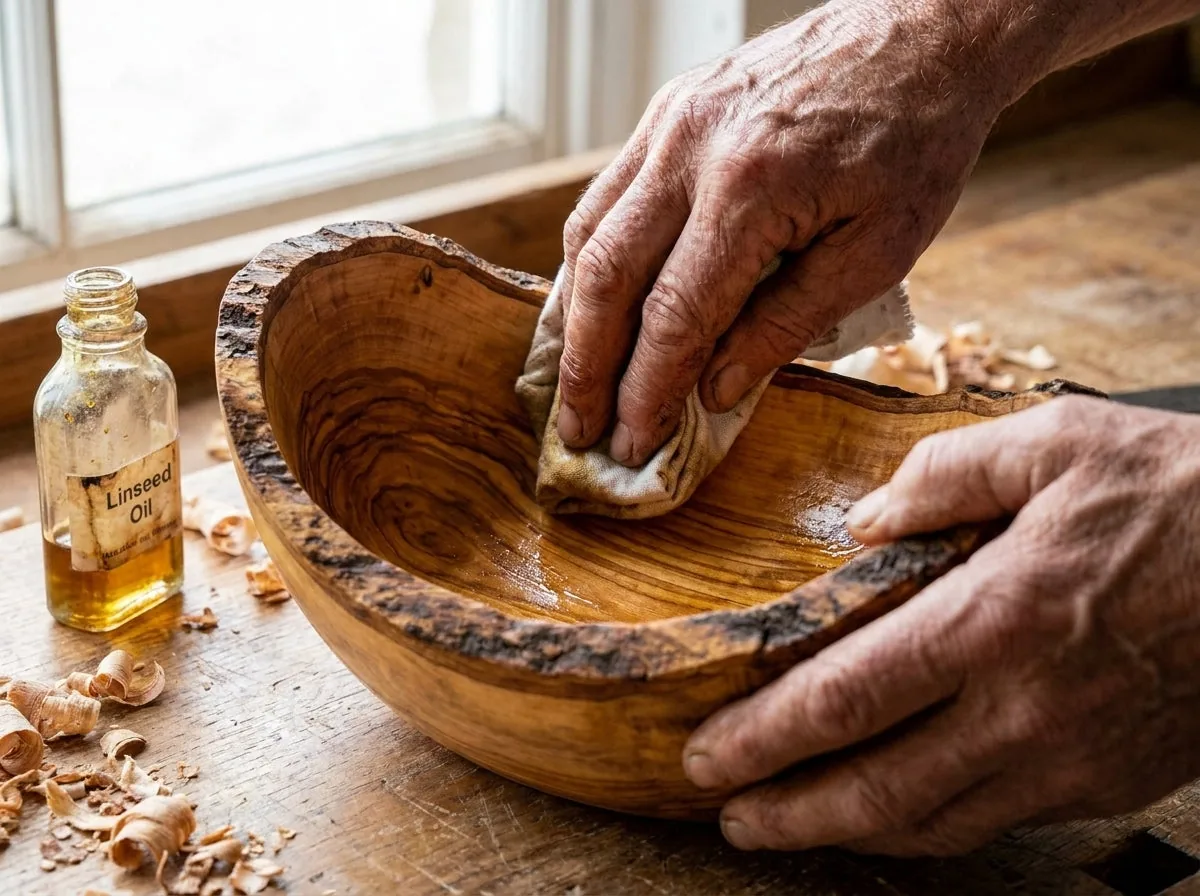
To understand why an Ostuni olive bowl costs what it does, you have to understand what happens to a tree that has spent a century pulling itself out of dry Apulian rock. The wood inside is not the wood of a young tree.
The grain swirls like wet smoke trapped under glass. It moves the way veins move in marble, except a vein in marble lies still and a swirl in olive wood travels visibly under your thumb. No two bowls are alike. Most factory bowls are.
'Olive wood has one enemy and it is dry indoor air,' Salvatore says. 'A bowl that is never fed, in a room with a radiator running all winter, will open along the grain. That is not the tree failing. That is the tree left thirsty. Oil it once a year and it will outlive the person who gave it to you.'
The process of turning a 100-year-old dead trunk into a serving bowl takes 14 months in Salvatore's workshop. There is no shortcut for the steps his father drilled into him in 1999.
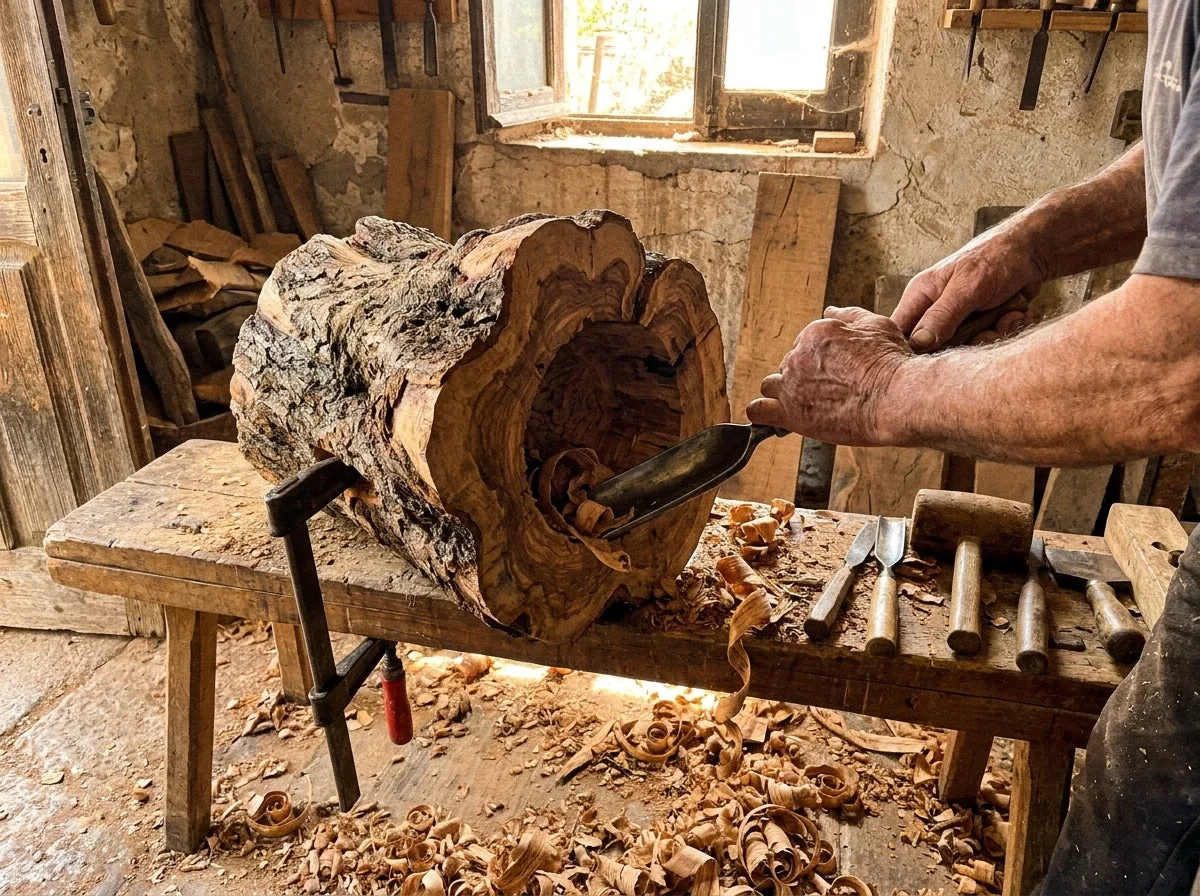
The trunk dries 12 months in open air. The bowl is hollowed out of that one piece with a curved gouge, never turned from staves and never glued. The bark rim stays untouched. Each bowl is worked across 4 grits in the workshop, oiled 3 times with cold-pressed linseed, and rested 10 days between coats.
From rough trunk to finished bowl, Salvatore invests 14 hours of workshop work per piece. He records each bowl number in his ledger as it leaves the workshop, and every bowl carries a lifetime warranty against cracking and splitting. He does not know another maker who writes that down. The last bowl of the final run will be number 142.
“"I have been running my palm around finished bowls for 27 years. There is a moment, after the last coat of linseed cures, when the wood goes warm under your hand. Like the tree never quite stopped being alive”
'One More Winter at the Gouge,' the Surgeon Told Him
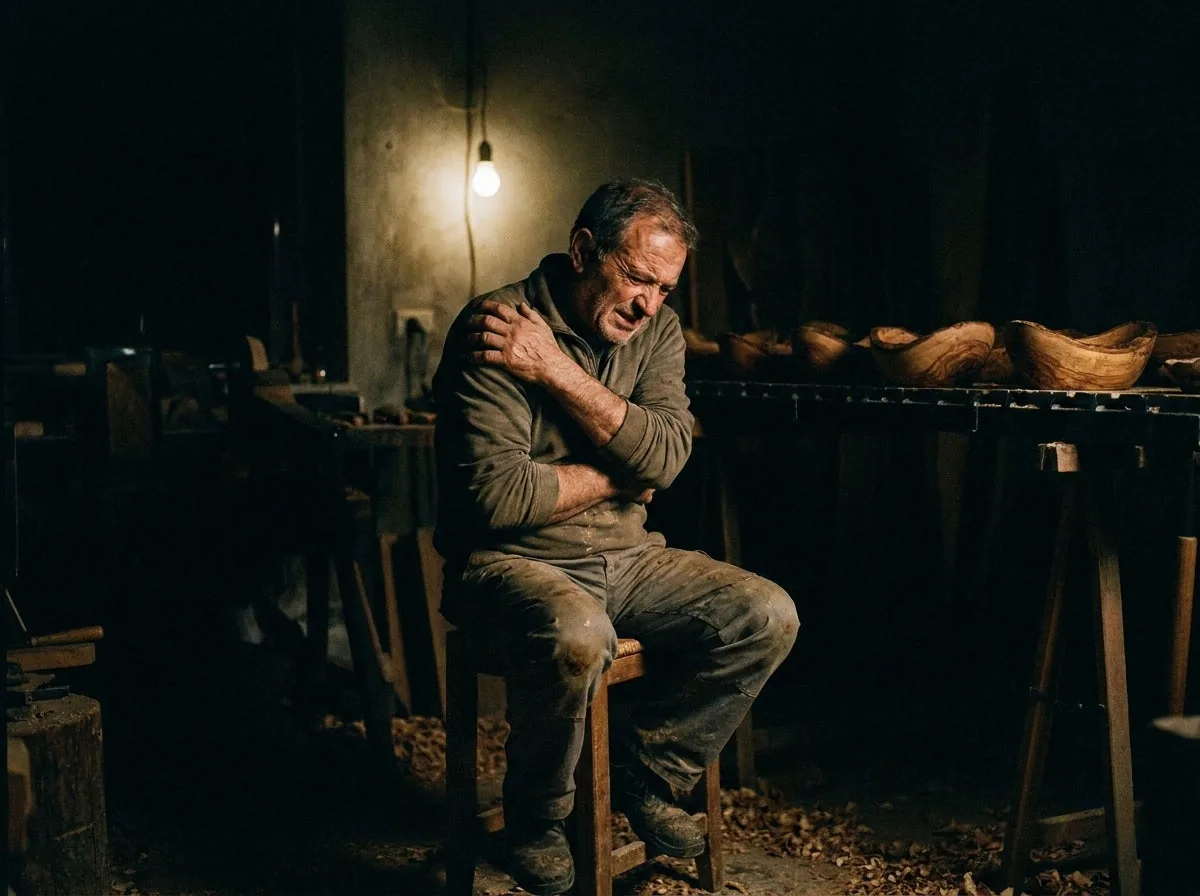
On March 3, 2026, a shoulder surgeon in Brindisi opened the scans in front of Salvatore. The tendons of his right rotator cuff had torn almost clean through.
'You have maybe one more winter at the gouge,' the surgeon said. 'After that, you will not lift your own arm to a shelf. Stop now, and you may still be able to pick up your future grandson without help.'
Salvatore had known for 2 years. The first morning he could not drive the gouge cleanly was the morning of his 62nd birthday. He had been strapping his shoulder before work and taking aspirin in the evening.
Rosaria had noticed 3 things: the strapping drying on the radiator, the bottle of olive oil moved from the kitchen to the bathroom for shoulder rubs, and Salvatore lifting his coffee cup with his left hand in the morning.
'Your father did not stop when his hand went,' Rosaria told him at the kitchen table that night, 'and he died in that workshop with a gouge in his fist. I am not burying you the same way.'
The line hurt because it was true. Salvatore had told himself for 2 years that quitting would be a betrayal of Domenico. Rosaria had named it correctly. Continuing would be the betrayal.
He sat with the decision through the night. By morning he had it in 2 parts. The workshop closes for good on December 19, 2026, the last working day his shoulder is likely to give him. And the 142 bowls on the drying racks would go directly to American families before he locked up, at the price his father had charged in 1999.
Why He Refused a Bari Buyer and Sent 142 Bowls to American Tables Instead
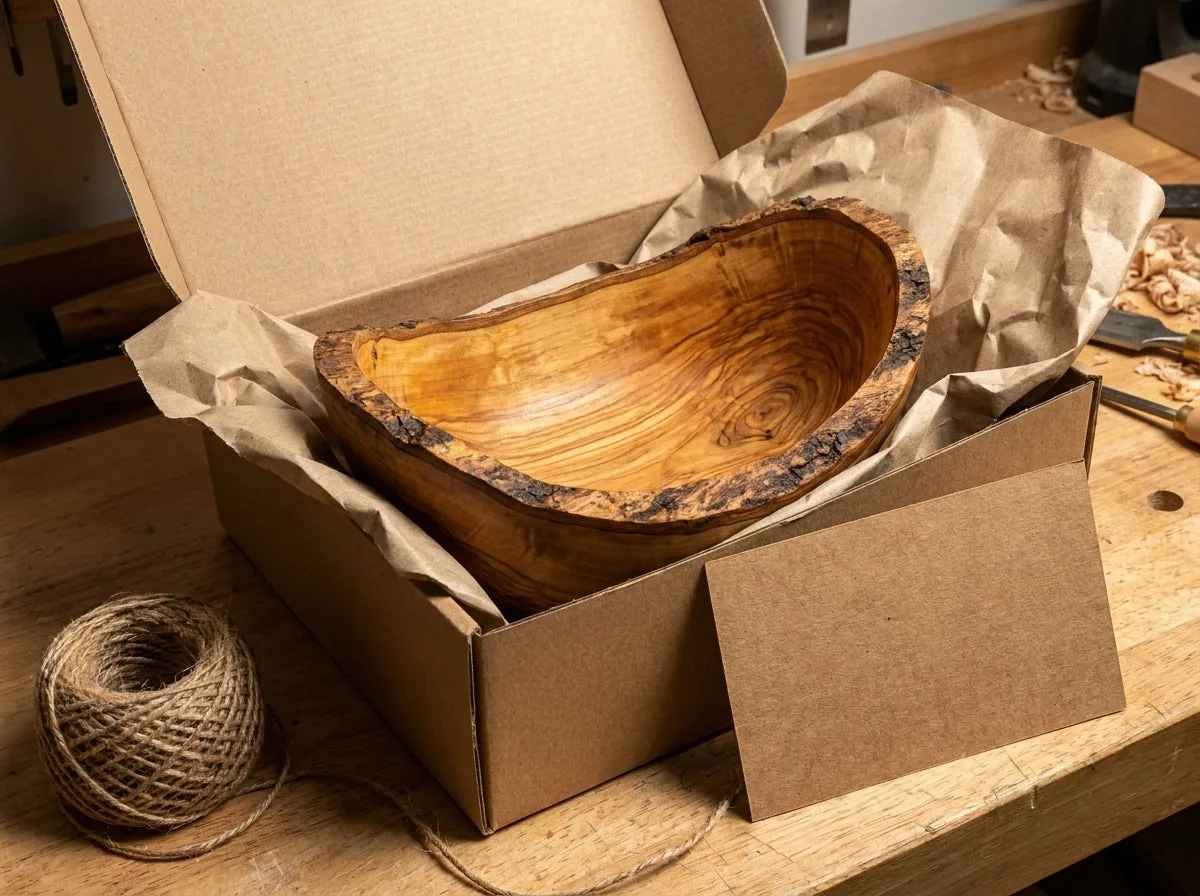
On April 6, the same Bari wholesaler who had stopped calling in 2019 reached out again. He had heard Salvatore was closing. He offered $29 apiece for all 142 bowls, to ship them to a luxury department store in New York.
Salvatore hung up before the man finished. The bowls his father had taught him to hollow were not warehouse inventory for a Manhattan retail buyer to sextuple the price on. They were dinner-table objects, made for the families that would actually use them.
The decision was to ship them directly to American households at $87 each, before the close. Sold through a distributor and a shop floor, the same bowl lists at $198, and in December a share of that markup is always paid by someone buying a present. That never sat right with Salvatore in the first place.
The 142 bowls are what the workshop finished before the closing date, and Salvatore is not starting another run afterwards. The trees Domenico uprooted in the 1970s have been at the workshop for nearly 50 years.
This is not a clearance. It is a values choice about who should own the last 142 bowls Salvatore will ever finish. He would rather one be unwrapped by a family on a December morning than resold behind glass to someone who will never eat out of it.
The Letters From People Who Were Given One
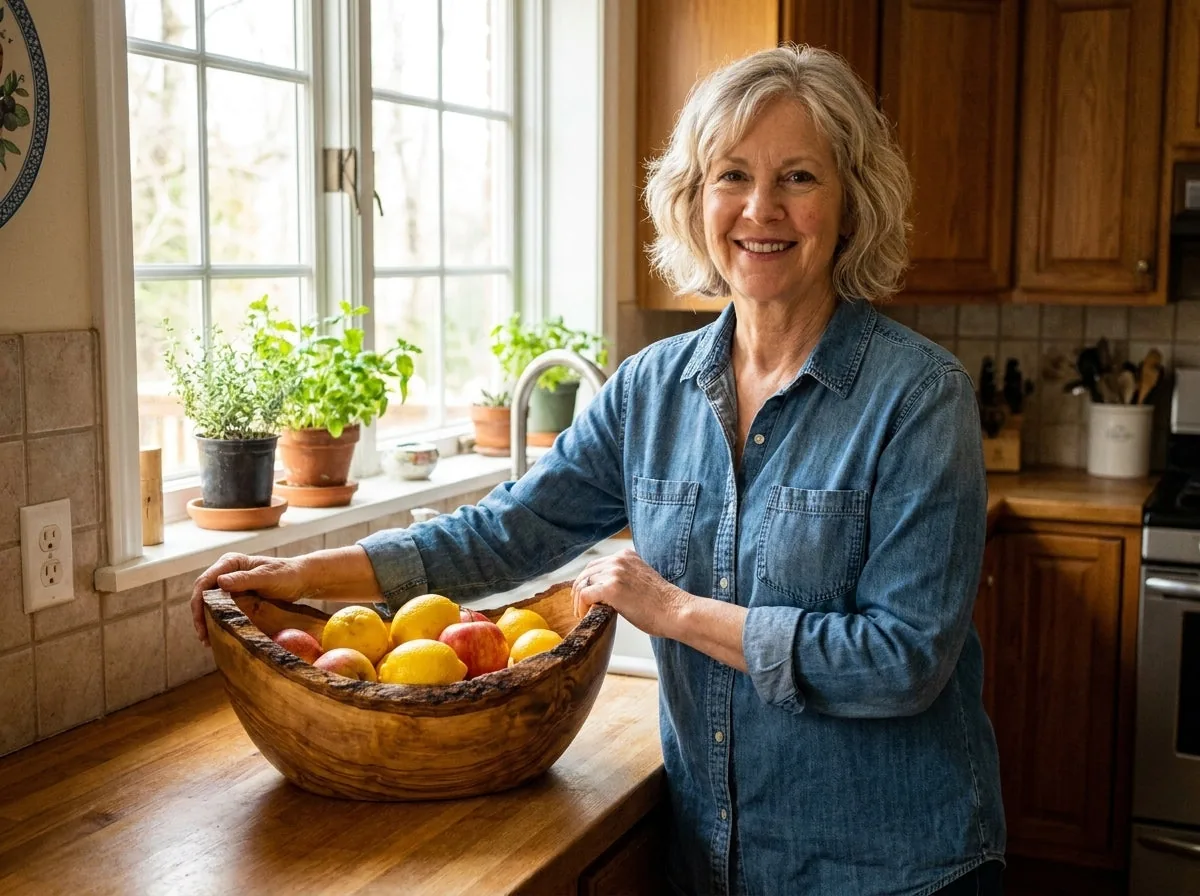
Word of the closure traveled fast through customer mailing lists in Boston, Chicago, Atlanta. Letters and emails began arriving at the workshop. What caught Salvatore out was how many were written by people who had never bought a bowl in their lives, because someone had given them one. A few are excerpted below.
“"I bought my bowl from Salvatore at a housewares trade fair in 2005. It has watched my 3 daughters grow up around our Sunday table. The grain is darker now. The rim has not moved a hair. When I read he was closing, I wrote to ask if he would put my name on the second-to-last one”
“"My late husband Frank received the bowl from our daughter in 2011 for his 60th birthday. He tossed the salad in it every Sunday and let nobody else near it. After he passed in 2022, I started using it again. It feels like he is still at the table when I do”
“"I have bought every serving bowl worth testing on the American retail market in the past 10 years for my restaurant. The Ostuni olive bowls Salvatore ships are denser and more visually individual than the turned acacia bowls I have bought before, and no two of them are the same”
The closure has been mentioned on 3 woodworking forums and in a short piece in a regional Italian paper, and a Puglia craft association offered Salvatore an honorary lifetime membership for his contribution to the trade.
He declined. 'My legacy is the 142 bowls on the racks behind me,' he wrote back. 'Put them on the dinner tables of American families. Not on the shelf of a museum that will not feed anyone.'
What Separates an Ostuni Bowl From Every Bowl in a December Catalogue
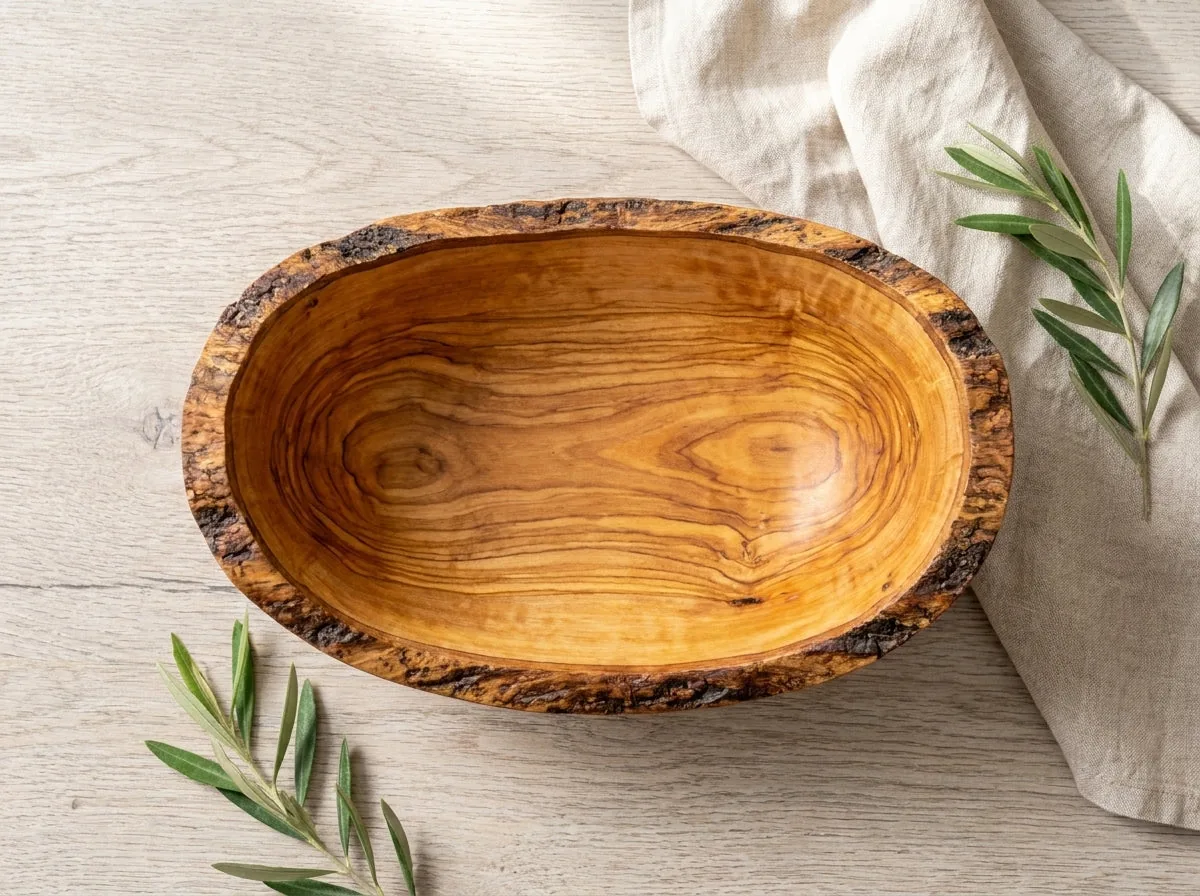
Here is what separates a Salvatore-finished Ostuni olive bowl from the mass-produced serving bowls stacked at the premium kitchen boutiques, the specialty cookware chains, and the big Italian-import names.
Single-trunk bark rim. Each bowl is hollowed from one piece of olive trunk and never glued. Factory bowls at the boutique counters and the flat-pack giants press or laminate staves together. Salvatore's bowls keep the natural bark line of the tree around the rim.
Cloth-rubbed cold-pressed linseed finish. Each bowl takes 3 oil coats over 30 days. The finish soaks into the dense olive grain instead of sitting on top. Over 10 years of use, the surface deepens into a honey-amber patina that mass-produced finishes cannot replicate.
Dense grain that will not drink. The swirled olive structure holds oil and vinegar the way acacia and bamboo do not. A dressed salad sits in it through a long dinner and the wood comes out of the sink the same colour it went in.
Lifetime warranty against cracking and splitting. Most bowls in this category are covered for 90 days, if at all. Every bowl that leaves Ostuni is covered for as long as it is owned, which is the part that matters when the bowl is going to somebody else. Upkeep is a damp cloth and one coat of mineral oil a year.
Workshop provenance. Each bowl leaves Ostuni with a numbered entry in Salvatore's ledger. Finished in the workshop, not on a production line. From the second-generation Ricci workshop in Puglia.
CHECK AVAILABILITYOnly 142 Bowls Will Ever Leave the Ostuni Workshop, The Door Closes December 19
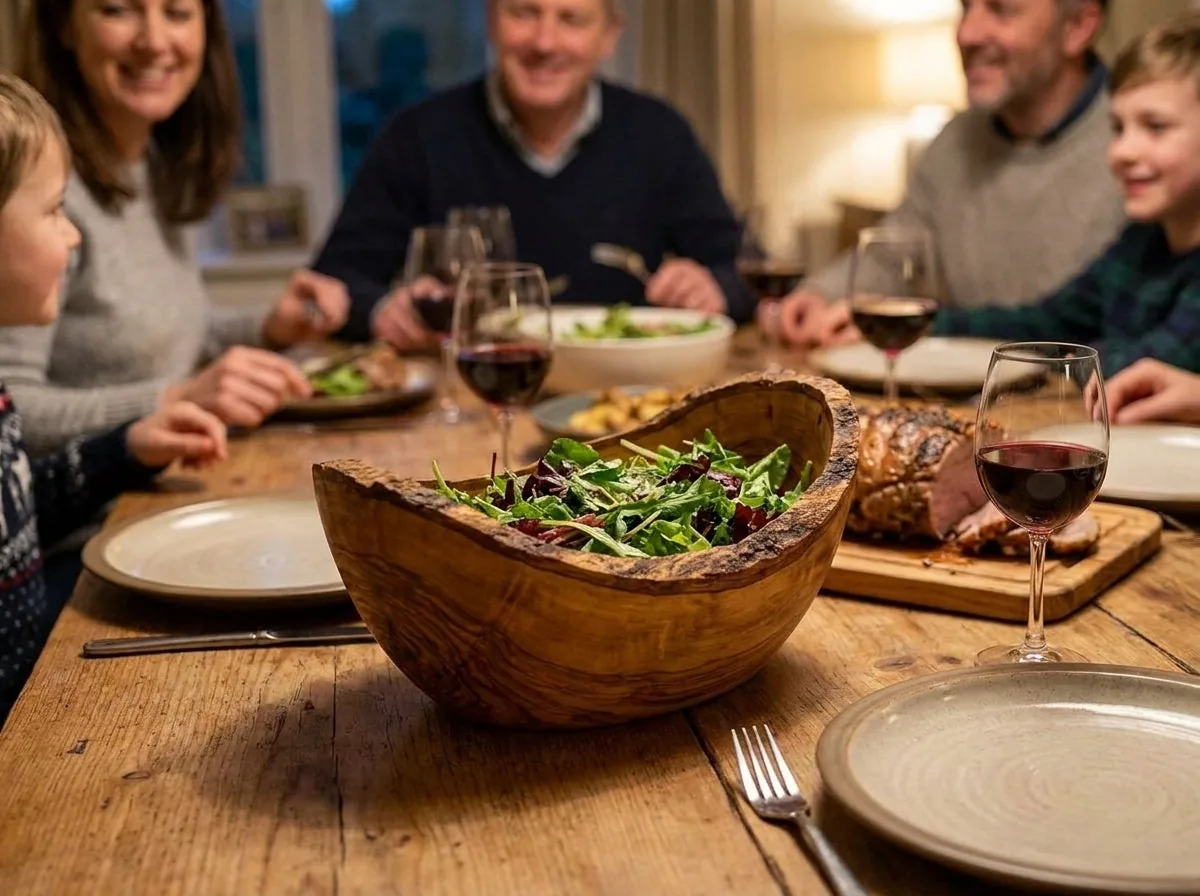
The drying racks behind Salvatore held 142 finished bowls when the workshop announced closure on April 10. When the 142nd bowl ships to America, the Ostuni workshop closes for good.
$87 against the $198 list price, framed not as a closing-down promotion but as the price Domenico Ricci charged before the markups began.
Each bowl is personally inspected, oiled one final time, and packed by Salvatore himself before leaving the workshop. Every bowl carries the lifetime warranty against cracking and splitting, plus a 30-day satisfaction guarantee. If the bowl is not exactly as described, the full refund returns to your card.
Early American buyers who received their bowls in the first shipping window have begun writing back. 2 of their messages follow.
“"The photo on the site did not prepare me for the weight or the smell of the wood when I unboxed it. My wife thought I had ordered stone. The first salad we served out of it on Sunday felt like ceremony”
“"I bought the bowl for my husband for his birthday and he has not stopped talking about the grain. He filled it with clementines the first night and traced the swirl with his thumb for 10 minutes”
Of the 142 bowls in the final run, 19 are still unclaimed at the time of writing. The workshop does not take back-orders once the racks are empty.
For the American host who actually cooks. For the person who has already given every obvious present and wants one that is still on the table in 20 years. For anyone who would rather buy one bowl once than replace a cheap one every few years.
Salvatore Ricci, second-generation olive wood workshop, Ostuni, Puglia, Italy